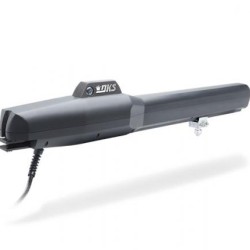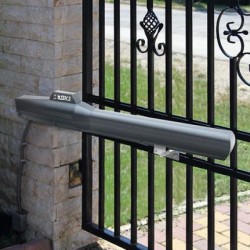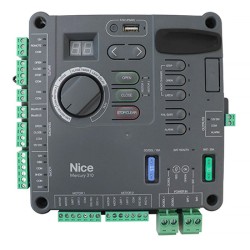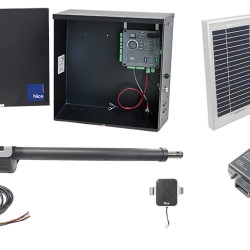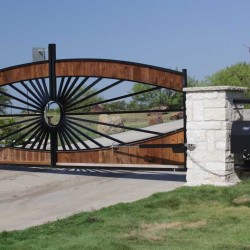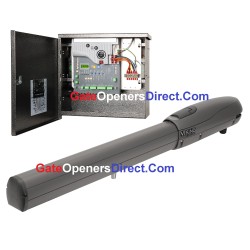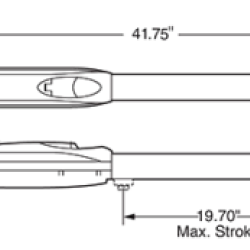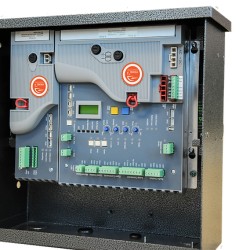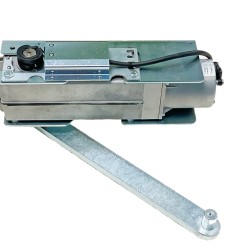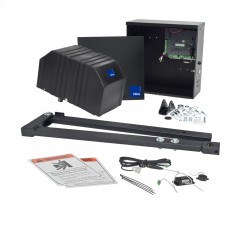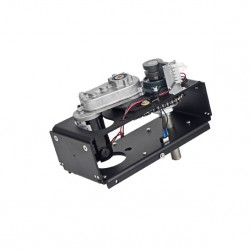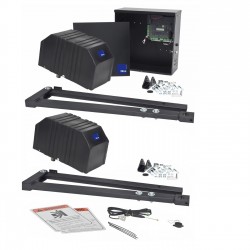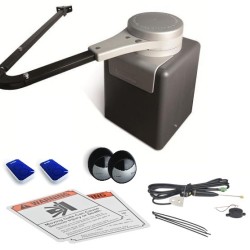
















Solar swing gate openers are the most common solar gate setup we sell, and for good reason. Swing gates are well-suited to solar power — they use less energy per cycle than slide gates, their motor loads are lower, and the battery recovers faster between uses. For a residential driveway gate where grid power isn’t accessible, or where the property owner simply wants a self-contained system that keeps working during outages, a solar swing gate opener is usually the cleanest solution.
The distinction from slide gates matters here. A swing gate pivots open from a hinge point rather than traveling a full track. Single-gate driveways need one arm; double-gate driveways need two. The opener is sized accordingly, and the solar components — panel and battery — are sized to match the motor load and daily cycle count of the specific application.
Why Solar Works Well for Swing Gates
Swing gates draw less power per cycle than slide gates because the motor only needs to pivot the gate through an arc rather than move a heavy load along a continuous track. That lower per-cycle energy demand means solar panels and batteries can be sized more modestly without compromising performance — and it means there’s more buffer for imperfect weather or higher cycle counts.
Single-arm residential applications are where solar swing gate openers really shine. A well-spec’d single-arm solar opener on a standard residential driveway, with reasonable daily traffic, will typically run for days on battery reserve alone before it needs to draw meaningful recharge from the panel. That makes these systems resilient across a wide range of climates and conditions.
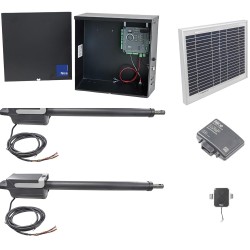
Dual-arm setups require a bit more attention to sizing. Two arms mean two motors and roughly double the per-cycle energy draw. On a dual-gate installation, I look for a larger panel — typically 20 watts or more — and a battery sized to handle the higher load without being stressed by multi-day cloud cover.
What Specs Actually Matter
When I’m evaluating a solar swing gate opener, these are the numbers I focus on:
Panel sizing. For single-arm residential installations, 10 to 15 watts is workable in most solar climates. For dual-arm installations, or any application in a cloudy region, I move up to 20 watts minimum. The panel is the system’s recovery rate — size it for your worst typical conditions, not your best.
Battery capacity. A 7 amp-hour battery is the baseline for a lightly used single-arm opener. For dual-arm setups or moderate to high daily cycle counts, 12 amp-hours gives you meaningful reserve. Cold climates reduce battery output — factor in a 15 to 25 percent capacity reduction at near-freezing temperatures when estimating your needs.
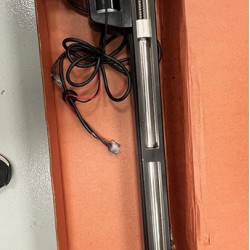
Arm type — single vs. dual. A single-arm opener handles one gate leaf. A dual-arm kit controls two gate leaves independently, opening and closing them in a coordinated sequence. If you have a double driveway gate, you need a dual-arm system. This isn’t a setting or accessory — it’s a different product category.
Cycle count rating. Most residential solar swing gate openers are rated for 20 to 50 cycles per day. Know your peak daily traffic and choose a system with a rating comfortably above it.
Our Solar Swing Gate Opener Lineup
Nice Apollo Titan 12L (Solar Configuration) — A reliable residential swing gate opener with a well-regarded solar option. The Titan 12L handles standard single-arm applications cleanly and is a strong choice for straightforward residential installations where simplicity and reliability are the priorities.
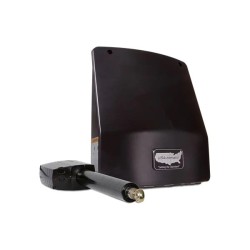
USAutomatic Patriot 1 — One of the most consistently recommended residential solar swing gate openers on the market. The Patriot 1 is purpose-built for solar operation with a well-engineered battery management system and US-based support. It handles single-arm residential applications well and is a top choice for buyers who want a quality system with minimal hassle.
FAAC 390 (Solar Configuration) — FAAC’s 390 is the choice for commercial applications or high-duty-cycle residential installations where build quality and long-term reliability are non-negotiable. FAAC engineering is over-built by residential standards, which translates to lower wear, longer service intervals, and a system that handles heavy use without degrading.