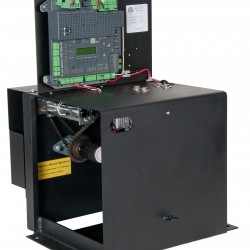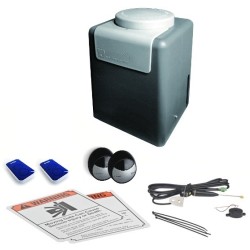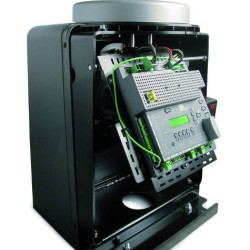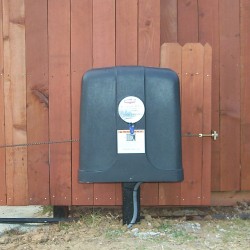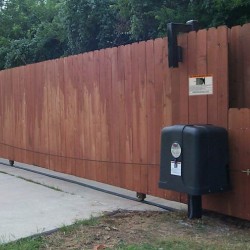
















Solar slide gate openers are the right solution for properties where running electrical conduit to the gate isn’t practical — whether that’s a remote ranch entrance, a long agricultural driveway, or a location where underground wiring would be prohibitively expensive. They’re also increasingly popular as backup-capable systems for properties that do have grid power but want gate operation to continue uninterrupted during outages.
Slide gates are one of the more demanding applications for solar power. Because the gate moves linearly along a track rather than pivoting, the motor runs under load for the full duration of each cycle. That means higher energy draw per cycle and a system that needs to be properly sized — both on the panel and battery side — to perform reliably.
Why Solar Makes Sense for Slide Gates
The practical case for solar on a slide gate comes down to access and resilience. Many slide gate installations are on rural or semi-rural properties where the gate sits at a distance from the nearest structure. Trenching conduit for 200 or 300 feet of buried electrical run can cost more than the gate opener itself. A properly spec’d solar system eliminates that cost entirely and gives you a self-contained power supply that isn’t dependent on utility infrastructure.
For properties that already have grid power, solar offers a meaningful advantage when the power goes out. A battery-backed solar system continues to operate during outages without any additional hardware — the battery that the solar panel keeps charged is the same battery that runs the opener during a grid failure.
Reliability in remote locations is the other factor. On a property where someone needs to call out an electrician to restore gate power after every outage, solar eliminates the dependency and the service call.
What to Look for in a Solar Slide Gate Opener
Not all solar slide gate kits are sized equally, and the spec sheet doesn’t always tell the full story. Here’s what I pay attention to:
Panel wattage. For slide gate applications, I want to see at least 20 watts on a residential installation. Lighter gates with lower cycle counts can get by on less in good solar climates, but 20 watts gives you meaningful recharge margin across most conditions. Step up to 30 watts for northern climates or higher-traffic applications.
Battery capacity. Slide gates need a robust battery — 12 amp-hours at minimum, and more if you’re running high daily cycle counts or dealing with cold winters that reduce battery output. The battery is the buffer between what the panel collects and what the opener actually uses.
Duty cycle rating. This is the maximum number of cycles the opener is rated to perform per day. Know your actual traffic before you buy. A system rated for 20 cycles a day is not appropriate for a gate that handles 35 cycles on a busy workday, even if the average is lower.
Gate weight capacity. Slide gate openers are rated by the maximum gate weight they can reliably move. Match the opener’s weight rating to your actual gate — with some headroom. Undersizing the motor is a common and preventable mistake.