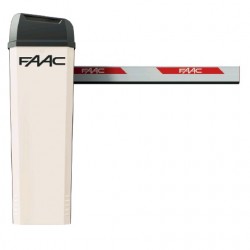

I've been in the gate and access control business for over 30 years. In that time, I've seen a lot of operators come and go, many products that looked good on a spec sheet but fell apart in the field, and a handful of brands that actually earned long-term trust. FAAC is one of those brands — and when it comes to barrier gates for commercial vehicle access, their equipment is about as close to a benchmark as you're going to find.
But here's the thing: barrier gates are a very specific solution to a very specific problem. They're not the right fit for every property. And if you're managing a parking lot, a hospital campus, a loading dock, or any high-traffic commercial entry, you need to understand not just which equipment to buy, but why barrier gates make sense for your situation in the first place.
That's what this article is about. I'm going to walk you through what a barrier gate is, when it makes sense over a slide or swing gate, why FAAC has earned its reputation in this space, and what to look for before you buy — including a detailed look at the FAAC B680H, which is one of the best commercial barrier gate operators on the market today.
What Is a Barrier Gate, and When Does It Make Sense?
A barrier gate — sometimes called a boom gate or parking lot gate operator — is a horizontally pivoting arm that rises and lowers to control vehicle entry and exit. The arm swings up to allow passage and drops back down to block it. That's the fundamental mechanism.
Compare that to a slide gate or a swing gate. Those are full perimeter gates — they're designed to secure an entire opening, deter unauthorized entry on foot and by vehicle, and provide a physical barrier that meaningfully protects what's behind it. A barrier gate arm doesn't do that. The arm manages traffic flow. It's not a security barrier in the crash-rated sense of the term.
So why use a barrier gate at all? Because for a large percentage of commercial applications, traffic flow management is exactly what you need — and for that, a barrier gate wins on every relevant metric:
- Speed. A barrier arm can open in 1.5 to 6 seconds. On a smaller drive of say approximately 10’ that arm does not weight much or have a large amount of leverage that it is exerting on barrier drive mechanism and consequentially will open much faster than a longer barrier arm. Arms as long as 26’ are naturally going to weight more, have much more leverage and be slower, but still much faster than a swing or slide gate. A slide gate covering a 20-foot opening takes considerably longer, usually about 1’ per second is an industry standard for economical models, but we do offer much faster openers with high speed openers. Feel free to call about those types of applications but they are far from the scope of this article about barrier arms. In a high-volume parking environment, that difference compounds across thousands of cycles per day.
- Cycle volume. Barrier gates are engineered for continuous-duty operation. The FAAC B680H is rated for over 2 million cycles.
- Footprint. Barrier gates require minimal space — no gate panel swinging into traffic, no track to maintain alongside a driveway.
- Integration. Barrier gates pair seamlessly with loop detectors, card readers, license plate recognition systems, and pay-on-exit kiosks.
Where barrier gates make the most sense: paid and managed parking lots, hospital and medical campus entries, apartment and condo parking garages, loading docks, event venues, university and government facility parking, office park lots with employee access control. Basically, drives where quick entry and exit are required, but foot traffic is not designed to be stopped on and off this kind of property.
Why FAAC for Commercial Applications?
FAAC is an Italian company that has been manufacturing gate and access control equipment since 1965. Seven decades of engineering refinement shows up in product durability, component quality, and design philosophy.
Global Track Record in High-Cycle Environments
FAAC equipment is installed in airports, hospitals, government facilities, and commercial parking structures on every continent. The brand has earned its reputation in exactly the high-demand environments we're talking about here. That track record is verifiable, not anecdotal.
Engineering Philosophy
FAAC designs its operators with hydraulic systems and precision machining that prioritize lifecycle performance. Where some manufacturers optimize for low production cost, FAAC optimizes for longevity. Their hydraulic designs are purpose-built for continuous-duty applications that would destroy a lesser operator.
UL and CSA Certification
For commercial installations in North America, certification matters. UL and CSA listings mean the equipment has been independently tested and meets recognized safety and performance standards — important for insurance, liability, and code compliance on commercial properties.
North American Parts and Support
FAAC maintains a robust North American distribution network. Parts are available. Technical support is reachable. When you're managing a 300-unit apartment garage and a component needs replacement, you can't wait weeks for an overseas shipment, and nothing is more frustrating than horrible tech support farmed out to “operators” reading from a script.
The FAAC B680H: A Closer Look
24V Hybrid Hydraulic — What That Actually Means
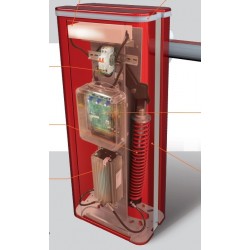
The "H" in B680H stands for hybrid hydraulic. Plain-English version: the B680H uses an electric motor to drive a hydraulic pump, which moves the arm. The hydraulic system absorbs the mechanical stress of each cycle. Instead of gears and cams taking millions of hard stops and starts, the hydraulic fluid cushions each movement. That's why the cycle rating is so high, and it's why these units hold up in environments that destroy gear-driven alternatives. The 24V system is also easier to integrate with low-voltage access control infrastructure and safer to service.
2 Million+ Cycles — What That Looks Like in the Real World
If you're running a parking facility that opens and closes 1,000 times per day — a reasonable volume for a mid-sized commercial lot — that cycle rating represents over five years of continuous operation before you'd reach the rated lifecycle. Many installations see considerably more service life than that. That's the kind of durability that justifies a commercial-grade investment.
Arm Length: 7.5 to 27.2 Feet
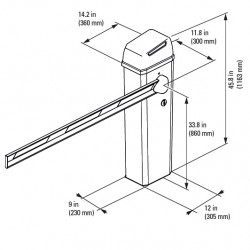
The B680H accommodates arm lengths from 7.5 to 27.2 feet — covering virtually every standard parking lane width. Articulating arm configurations are available for low-clearance situations.
Open Time: 1.5 to 6 Seconds
Opening speed is adjustable from 1.5 to 6 seconds. In a high-throughput environment, the ability to dial to 1.5 seconds is significant. Faster open time means less vehicle stacking at peak periods.
Integrated Speed and Position Sensor
A built-in encoder continuously monitors arm position and speed during operation — enabling precise movement control and obstacle detection. If the arm encounters unexpected resistance, the system detects it and responds. That reduces the risk of arm-vehicle contact incidents.
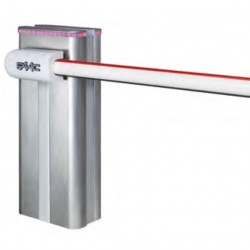
Optional LED Arm Lighting
LED lighting on the barrier arm dramatically improves arm visibility for drivers at night and in adverse weather. For parking structures with low ambient light or any facility operating around the clock, it's worth specifying upfront.
Real-World Applications Where the B680H Shines
Hospital and medical campuses — 24/7 operation with constant patient, visitor, staff, and emergency vehicle throughput. Downtime is not acceptable. The B680H's cycle rating and hydraulic durability match this environment.
Apartment and condo parking garages — Residents use the entry twice a day, every day. Across 100–200 units that's substantial daily cycle volume. The B680H handles it without the maintenance burden of lighter-duty equipment.
Municipal and government facilities — Often require UL-listed commercial equipment with long service life and minimal maintenance overhead. The B680H checks both boxes.
Event venues — Thousands of vehicles arriving and departing in compressed windows. The 1.5-second open time and continuous-duty design handle burst demand without overheating or degrading.
Office parks and corporate campuses — Clean integration with card readers, fobs, and LPR systems. Morning arrival and evening departure peaks are manageable at fast open speeds.
Universities — Mix of permit holders, visitors, and metered spaces across large properties. The B680H's compatibility with loop detectors, pay stations, and credential readers supports layered access control needs.
Barrier Gate vs. Slide or Swing Gate: How to Choose
- I want to clarify this because I often see it misunderstood. A barrier gate arm controls traffic flow but doesn't secure a perimeter. Vehicles or pedestrians can bypass it by going around or underneath. If you need to physically secure an opening from unauthorized vehicles, consider using a slide gate, swing gate, or crash-rated barrier.
- Traffic flow management in a managed access environment involves barrier gates that are fast, capable of high cycles, have a low footprint, and integrate seamlessly with access control systems.
- For perimeter security where unauthorized intrusion might be a concern, consider using a slide or swing gate. They provide full opening coverage, act as a physical deterrent, and are available in crash-rated options for added safety.
- Mixed-use setups can often feature a barrier gate managing the main vehicle lane, while a full perimeter gate takes care of secondary or emergency access. These setups are quite common and worth discussing carefully with your integrator to ensure everything runs smoothly.
Here's what you should consider before making a purchase:
- Arm length: Measure your lane width carefully. The B680H covers from 7.5 to 27.2 feet, but it's best to double-check before placing your order.
- Cycle volume: Be honest when estimating daily cycles, especially during peak times. If you're handling around 2,000 vehicle movements per day, you'll need a robust, commercial-grade operator capable of high cycles, not just a light commercial model.
- Access control integration: The B680H supports various access systems like loop detectors, card readers, LPR, intercoms, and pay stations. Make sure to clarify your specific needs beforehand and work with an expert who is familiar with both the gate equipment and access control software.
- Power supply: This model runs on 24V. Check the availability of power at your installation site and plan your wiring and conduit accordingly.
- Articulating arms for low clearance: If your structure has a low ceiling, consider specifying articulating arms early. They fold at the midpoint as they lift, which helps save height.
- LED arm lighting: For entries that operate overnight, indoors, or in limited daylight, adding LED lighting to the arm is a great safety feature. It's easier and less costly to include this in your initial setup than to add it later.
- Local regulations and safety standards: Be sure to know the relevant UL listings, entrapment protections, and other safety certifications required for your installation to select the right equipment.
Ready to Find the Right FAAC Barrier Gate for Your Property?
The next step is finding the perfect equipment to suit your unique needs — whether it's arm length, how often you use it, access control preferences, or special site features like low clearance or overnight operation.
At Gate Openers Direct, we offer the FAAC B680H and the full range of FAAC commercial barrier gate operators, along with all the accessories, arms, and integration components you need for a seamless system.
Browse FAAC Barrier GatesIf you’re ever unsure about your specific setup — whether it’s lane width, cycle volume, integration needs, or anything else — don’t hesitate to reach out. With over 30 years of experience in this industry, I’ve seen just about everything, and I’d be happy to help guide you in the right direction.