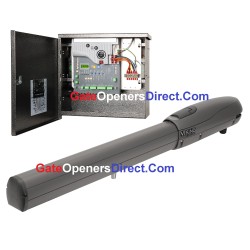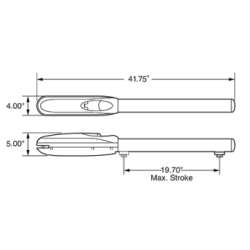

At Gate Openers Direct in Houston, Texas, we will help each customer customize a complete setup for their particular gate and location. Before any customer pulls the trigger on a solar gate opener, I walk them through the basics and ask about the future location of the gate opener. After 30 years of experience, I have found that most of the information to follow is an engineer's dream, but in the real world, the basics are what matters most. What’s actually in the package. Not because I’m trying to manage expectations, but because I’m genuinely trying to prevent the frustration of getting everything home, opening the box, and realizing you’re missing something you need to get the job done.
A solar kit is more than just a gate operator with a panel thrown on top. Several interdependent components make it up, and understanding what each one does helps you evaluate whether a particular kit is the right match for your application. So let me break it down for you the way I’d explain it on a call.
The Solar Panel
The solar panel is the most visible component of the kit, and it’s the piece people tend to focus on — but it’s not where I’d start when evaluating a kit.
Solar panels used in gate opener kits are small-format photovoltaic panels, typically ranging from 5 watts on the low end to 40 watts for more robust systems and even higher on some very heavy duty specialty applications. Residential solar slide and swing gate kits most commonly include 10-watt to 20-watt panels, which is adequate for moderate-duty residential applications in a reasonably sunny climate, as long as you do not try to power other equipment off the opener. LED lights and other “niceties” at your gate need their own solar power supply.
The solar panels convert sunlight into DC electricity and send it to the battery through a charge controller (more on that below). Efficiency varies by manufacturer, but the key specs to pay attention to are:
Rated wattage — how much power the panel produces under ideal test conditions
Open-circuit voltage (Voc) — the voltage the panel produces with no load
Panel dimensions — relevant for mounting and placement
Most kits at Gate Openers Direct include a mounting bracket or arm that lets you position the panel at an angle to maximize sun exposure. The specific angle and orientation will depend on your latitude and where your gate is situated relative to shade and obstacles.
One thing I always tell customers: the rated wattage assumes full, direct sun. Real-world output is typically 70 to 80 percent of the rated spec once you account for temperature, angle, and atmospheric conditions. Also, dirt, snow, etc., on the panels can significantly affect how much energy they produce.
The Battery
If the panel is the engine, the battery is the fuel tank — and honestly, the battery is the component that determines how reliable your solar gate system actually is.
Most residential solar gate kits include a sealed lead-acid (SLA) battery, either in an AGM (absorbent glass mat) or gel configuration. These are maintenance-free, spill-proof, and reasonably well suited to the charge-discharge cycles a gate opener undergoes. Capacity is typically expressed in amp-hours (Ah) — you’ll commonly see 7Ah, 12Ah, or 18Ah batteries in POOR QUALITY residential kits. A professional-grade opener will accommodate a larger battery such as a typical car-sized unit. Your battery is your STORE OF ENERGY for periods when it's cloudy, snow on panels, etc. Also, and equally important, larger batteries are usually higher quality, hold more reserve energy, and last longer.
A larger Ah rating means more stored energy and more reserve for cloudy days, nights, and high-cycle periods. A 7Ah battery is fine for a low-traffic gate in a sun-rich area; an 18Ah battery gives you a meaningful buffer if you’re expecting several days of overcast weather or higher daily cycle counts.
How long the battery lasts between replacements depends on several factors:
Cycle frequency — more daily opens and closes means faster degradation
Temperature — extreme heat shortens SLA battery life; extreme cold temporarily reduces capacity
Depth of discharge — frequently draining the battery below 50 percent accelerates wear
Under normal residential use, expect 3 to 5 years from an SLA battery before performance noticeably degrades. Lithium batteries, available as aftermarket upgrades, can last significantly longer and handle deeper discharge cycles better — but they’re not always included in standard kits.
The Controller/Logic Board
The controller — sometimes called the logic board or control board — is the brain of the whole operation. It manages everything: when the gate opens and closes, the motor speed and torque, safety features, and battery management. At Gate Openers Direct in Houston Texas, we sell solar-specific kits. In these, the control board typically includes built-in solar charge regulation. This means the controller monitors the battery’s state of charge and regulates the current from the panel to prevent overcharging, thereby extending battery life. Some controllers also have a low-battery cutoff that prevents deep discharge from damaging the battery.
On top of the solar management functions, the controller handles:
Accessory inputs — wiring connections for keypads, loop detectors, exit wands, safety edges, and photo-eye sensors
Timer settings — auto-close timing, open/close limits, and entrapment reversal sensitivity
Communications inputs — receiver connections for remotes or RFID readers
The control board is usually the most sophisticated part of the kit and the most expensive to replace if it’s damaged, so protecting it from moisture and direct sun exposure with a proper enclosure is important.
Wiring and Hardware
Most solar gate kits include the wiring and hardware needed to connect the major components to each other — but this is also where kits vary the most between manufacturers, and where buyers sometimes run into gaps.
What’s typically included:
Panel-to-battery wiring — the cable connecting the solar panel output to the battery/controller
Battery connectors or terminal hardware — for making the battery connection
Mounting hardware for the panel arm — bolts, brackets, and sometimes a mounting post adapter
Operator mounting hardware — the brackets, bolts, and hardware to mount the operator itself to the gate post
What’s typically NOT included in the wiring bundle: wire for running accessories like keypads, exit wands, or loop detectors out to their installation points. That wiring varies too much based on your specific installation layout to bundle cost-effectively into a standard kit.
What’s Usually NOT Included
This is the part of the conversation where I save customers a trip back to the hardware store.
What most solar gate kits do not include:
Gate hardware — hinges, latches, and the physical gate structure itself are almost never part of an opener kit.
Battery - these are best purchased locally for several reasons. Warranties on batteries are easier to handle locally, but also batteries are heavy and very expensive to ship. In addition, a company like WalMart can offer prices that gate opener companies can rarely match.
Additional wire runs — if your keypad is 50 feet away from the operator, you’ll need to source and run that wire yourself
Conduit or wire management — protecting wiring runs from weather and physical damage is your responsibility
Concrete or post installation materials — mounting the operator post or anchoring hardware requires materials specific to your site
Alarm/strobe lights — some installs require flashing warning lights; these are almost always add-on accessories
Phone entry systems or video intercoms — these are separate products that integrate with the control board but are not included
Ground rod or grounding hardware — proper electrical grounding for lightning protection
The more complex your install — multiple access points, long wire runs, safety loop detection — the more you’ll need to add beyond the base kit.
Kit vs. Add-On Solar — What’s the Difference?
There are two distinct ways solar gets paired with a gate opener.
A solar kit is an all-in-one package: the operator, solar panel, battery, and charge controller are all included and sized to work together. The operator itself may be a solar-only design, meaning it doesn’t have an AC power input at all and runs exclusively from the battery. This is common in residential solar swing and slide gate kits from USAutomatic and Viking.
Add-on solar means taking a standard AC-powered gate opener — one that normally plugs into the grid — and pairing it with a separate solar charging kit. The operator typically has a battery backup input, and you’re adding a solar panel to charge that battery rather than relying on AC. FAAC, Viking and HySecurity offer compatible add-on solar options for certain models in their lineup THAT ARE SPECIFICALLY DESIGNED TO BE SOLAR FRIENDLY. Taking a gate opener that is designed for AC power and trying to throw a couple of solar panels at it DOES NOT WORK.
The distinction matters because solar-only operators are typically engineered from the ground up for low power draw. They’re optimized to squeeze maximum performance out of a limited battery budget. A standard AC operator adapted to solar may draw more standby power and be less efficient on batteries, worth understanding when you’re comparing options.
Example: USAutomatic Patriot RSL Solar Slide Kit
At Gate Openers Direct in Houston, Texas, the USAutomatic Patriot RSL is one of the solar slide gate kits I recommend most frequently for residential applications, so it’s a good real-world example of what a complete kit looks like.
The Patriot RSL package includes the operator unit itself, a 20-watt solar panel with a mounting arm, and all the primary wiring to connect those components. The control board has built-in solar charge regulation and low-battery protection. It’s designed to handle a standard residential slide gate — up to 30 feet and 1,000 pounds on most configurations — with a daily cycle count appropriate for a private driveway.
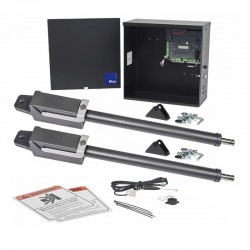
What it doesn’t include: battery, gate hardware such as hinges, wheels, etc., accessory wiring runs, a phone entry system, exit sensors and other peripheral devices that we offer as options. What you see in the box is what you need to run the operator — everything else depends on your specific installation.
When I’m helping a customer spec this out, the next conversation is always about their daily cycle count, their climate, and what accessories they need — because those factors determine whether the included battery is sufficient or whether upsizing makes sense.
What to Ask Before You Buy
When you’re comparing solar gate kits, these are the questions that actually matter:
What is the panel wattage, and is it sufficient for my climate and cycle count? A 10-watt panel is adequate for low-traffic gates in sunny climates. Higher cycles or less sun means you need more wattage.
What is the battery capacity (Ah), and does it provide enough reserve? Bigger isn’t always necessary, but knowing the buffer you have on cloudy days matters.
Is the charge controller integrated or separate? Integrated is simpler; separate gives more flexibility but adds complexity.
What is the operator’s standby power draw? Lower standby draw means the battery depletes more slowly when the gate isn’t cycling — important in low-sun periods.
Is this a solar-only design or solar-ready AC? Knowing this helps you understand its power architecture and efficiency.
What accessories do I need that aren’t included? Be specific about your site requirements before you order.
Frequently Asked Questions
Q: Can I upgrade the battery in a solar gate kit to a larger capacity?
A: In most cases, yes. The battery is a standard format component — typically a 12V sealed lead-acid in a standard group size — and you can replace it with a higher-capacity unit as long as the voltage matches what the controller is designed for. Going from a 12Ah to an 18Ah or 24Ah battery is a common and sensible upgrade for customers in cloudy climates or with higher daily cycle counts.
Q: Can I add a second solar panel to a kit?
A: It depends on the controller. Some solar gate controllers have a single panel input rated for a specific wattage, and exceeding that with a second panel can damage the controller. Others are designed to accept higher input from larger or multiple panels. Always check the controller’s maximum solar input spec before adding panels. When in doubt, contact us before you buy an additional panel.
Q: What happens to the gate if the battery dies completely?
A: Most solar gate operators include a manual release that lets you open and close the gate by hand if the battery is fully discharged. It typically involves a key release on the operator that disengages the motor from the gate mechanism. Knowing where this is and how to use it before you have an emergency is worth the two minutes it takes.
Q: Does a solar gate kit come with a remote control?
A: Most do include at least one or two remote transmitters, but this varies by kit. Check the specific product description to confirm what’s included. Additional remotes, keypads, and access control devices are typically sold separately.
If you’re ready to explore your options, our solar slide gate openers and solar swing gate openers at www.GateOpenersDirect.com show the full range of kits we carry — complete with specs so you can compare panel wattage, battery capacity, and included accessories before you decide. Thank you for your consideration of our company!