Key Takeaways
- Gate Openers Direct in Houston, Texas, has been a legacy distributor in the access control industry since 1999. We are located at 1651 Blalock #B1, Houston, TX 77080. We proudly represent HySecurity and its full line of Hostile Vehicle Mitigation (HVM) products.
- HySecurity regularly holds HVM training sessions nationwide. This training certification is required to qualify for purchases of these special barriers.
- Hostile Vehicle Mitigation (HVM) uses crash-tested barriers to protect high-value, high-security properties. These barriers are rated to stop a vehicle from being driven into a building, a crowd, or secure areas such as federal buildings, airports, military facilities, prisons, and more.
- HySecurity's HVM line covers every type of perimeter opening: crash-rated bollards, the HydraWedge SM50 wedge barrier, StrongArm M30/M50 barrier arms, the StrongSlide M30 slide gate, and the WedgeSmart DC.
- Obviously, the right product depends on the type of threat (vehicle size and speed), how approved traffic ingresses and egresses the property, and the site “Ground Specifics”. As you can see, making the right choices can be complex, depending on the foundation buried beneath the site.
- At the dedicated HySecurity plant in Kent, Washington, we build these barrier systems to order to match each opening's specifications. Once completed and tested, the units are shipped directly to the job site. Gate Openers Direct in Houston, Texas, can handle the specs, the quote, and the distributor paperwork.
With over 30 years in the gate and access control business, I can say hostile vehicle mitigation is the most serious equipment we sell. A regular gate opener keeps honest people honest. An HVM barrier is built to stop vehicles, such as a truck that is being used as a weapon by deliberately driving through a perimeter-gated installation. It has to work the first time, every time.
Hostile vehicle mitigation simply means using crash-rated barriers to keep a vehicle from reaching a protected building, entrance, or group of people, whether the driver intends harm or simply loses control. What separates an HVM barrier from everything else is that it has been tested by running a real truck into it at a set speed and measuring how far the truck traveled.
Some of our most recent projects include large manufacturing facilities, federal courthouses, IRS locations, ICE facilities and other similar locations where there can be no failure to stop such threats.
What hostile vehicle mitigation does -
Consider a secure site as a series of layers. Fencing and access control determine who is permitted to enter, while HVM ensures that unauthorized individuals cannot simply drive through. This is why HVM is used at government buildings, military bases, airports, power and water utilities, data centers, stadiums, and large corporate campuses.
Each HVM barrier is evaluated based on a central question: when struck by a vehicle of a specified weight traveling at a specified speed, does it stop the vehicle, and how far beyond the line does the vehicle travel? Crash ratings such as M30 and M50 provide this information. I explain these ratings in plain English in Crash Ratings Explained (article coming soon).
The HySecurity HVM lineup -
Decades of HySecurity equipment production have solidified their reputation as a top-line manufacturer. Their hydraulically activated swing and slide gates are some of the toughest and most reliable in the industry. As a result, architects, security professionals, and developers who demand the finest, most reliable equipment specify them. Their HVM line, now part of the Nice group, has a product for every opening on a secure perimeter.
Bollards M30/M50
Fixed and removable crash-rated bollards protect building façades, plazas, and walkways while allowing pedestrians to pass between them. Shallow-mount options are available for sites with underground utilities, while deep-mount options require less surface space. HySecurity designs, tests, and manufactures its bollards in the United States, which matters to me and many of my government customers. Learn more in my guide to crash-rated bollards and wedge barriers (coming soon).
HydraWedge SM50
The HydraWedge is a hydraulic wedge that rises from the roadway. It is rated ASTM F2656 M50 P1 and has also passed PAS 68 and IWA 14-1 testing with negative penetration, meaning the test truck did not pass the barrier line. In normal operation, it opens or closes a lane in approximately three seconds, and HySecurity rates it for up to 300 vehicles per hour. This barrier is designed to be cycled for every vehicle, rather than raised only in an emergency.
StrongArm M30/M50
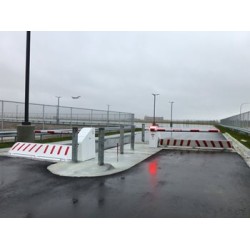
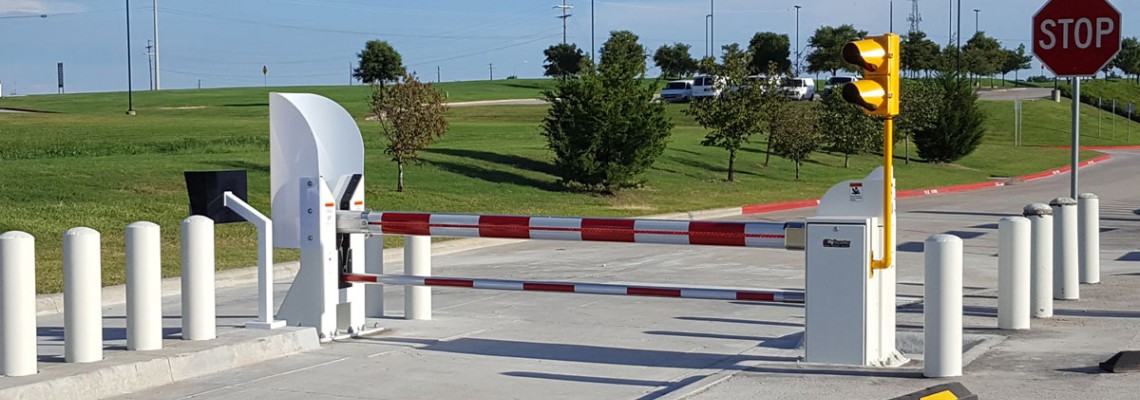
The StrongArm is a crash-rated barrier arm equipped with two arms. The lower arm is positioned at bumper height, while the upper arm features LED lighting and reflective tape to improve visibility and reduce the likelihood of injury in a collision with a passenger vehicle. The M30 and M50 models are rated to stop a 15,000-pound truck traveling at 30 mph and 50 mph, respectively. The system uses the same HySecurity hydraulics that I have relied on for high-cycle gates for years.
StrongSlide M30
The StrongSlide M30 is HySecurity's first crash-rated slide gate and offers a complete solution, combining a steel cantilever gate on a bottom track, the operator, and the crash barrier in a single unit. It is rated M30 P1 and provides a 24-foot clear opening, which HySecurity describes as the widest among crash-rated slide gates in the industry. The system also restricts pedestrian access, allowing one gate to serve two functions. It is available with a powder-coated or galvanized finish, and its hardware is covered by a 500,000-cycle warranty.
WedgeSmart DC
The WedgeSmart DC combines a wedge with a barrier arm. It is designed to stop passenger vehicles traveling at speeds of up to 30 mph, making it primarily a theft-prevention solution for dealerships, rental lots, and fleet yards rather than an anti-terrorism barrier. For facilities experiencing vehicle theft, it represents a significant upgrade over a standard parking arm.
There is no “one” unit in the HySecurity HVM lineup, better than the other. We do sell contractors more of the “StrongArm” models simply because they are less labor-intensive to install and are easier to “retrofit” for upgrading older properties where the infrastructure is already in place.
How I help customers choose an HVM barrier
Start with the threat, not the product
The project spec or the site's security assessment should tell you what size vehicle and what speed the barrier has to stop. If the spec says M50, that means a medium-duty truck at 50 mph, and nothing rated lower will pass it. Never guess at this. If the spec doesn't say, get the owner or the security consultant to put it in writing before anyone orders anything. At this level, use a certified professional to estimate the threat-mitigation level for each installation.
Match the product to the opening
- Building fronts and pedestrian areas: bollards.
- Vehicle lanes with steady traffic: HydraWedge or StrongArm.
- A fence line that also needs a working gate: StrongSlide M30.
- Fleet yards and theft problems: WedgeSmart DC.
Be honest about traffic
A guard booth that checks hundreds of trucks a day needs a barrier that can cycle all day long, dependably, for years with little wear, but proper maintenance. That's exactly what the HydraWedge's 300-vehicle-per-hour rating and the StrongArm's hydraulics are built for. Underbidding or under-specifying here is the most expensive mistake you can make.
Look underground before you bid
Foundations, drainage, and buried utilities account for a considerable amount of the process to correctly spec these jobs. That's why shallow-mount bollards exist. Get utility locates and soil information early, before the numbers are locked in. Your professional designers on your perimeter security team should always take this into consideration on new construction, but on site upgrades it is crucial in your planning phases to accommodate existing structures underground.
What buying HVM equipment is really like
These systems are not pre-produced or held in warehouse inventory. Each barrier is custom-built to order and shipped directly to the job site, accompanied by a comprehensive set of submittals. The new owners will require crash-test documentation, compliance records, and final approvals. These projects involve substantial financial investment. Budgets for this level of security and protection are determined by need, rather than the reverse. We complete all planning and specification work before placing an order to ensure the specifications, product, and site requirements align.
Preparing the most competitive quotation, managing distributor paperwork with HySecurity, and coordinating shipment to the project site are among the ways our attention to detail helps our customers present themselves professionally. This traditional approach to coordination is essential to keeping projects on schedule and within budget. Although some systems may take several months to manufacture, HySecurity consistently treats these orders as a top priority. Its world-class reputation is at stake with every order it accepts and fulfills. If HySecurity trusts Gate Openers Direct in Houston, Texas, as a partner, you can too!
Frequently asked questions
What does HVM stand for?
Hostile Vehicle Mitigation: barriers and site design that protect lives by keeping potential vehicles from being used as weapons to attack a building or crowd.
What's the difference between crash-rated and crash-engineered?
A crash-rated barrier passed a full-scale crash test under a recognized standard like ASTM F2656 and earned a rating such as M30 P1. "Crash-engineered" or "crash-resistant" usually means it was designed to take a hit but doesn't carry a certified rating. If the spec calls for a rating, only a certified product will pass.
Can I just beef up a regular gate opener to stop vehicles?
In almost all cases, not to these standards. Even the strongest gates and “off-the-shelf” openers aren't built or tested to these “life safety” standards. If a site justifies these levels of protection, it needs vehicle mitigation protection protocols and a crash-rated barrier.
Does Gate Openers Direct sell HySecurity HVM products?
Absolutely, we do! Call me at 713-330-3333 so that we can coordinate a professional quotation of your spec’d needs.
Bidding an HVM project? Call Gate Openers Direct.
If you're working on a job that calls for crash-rated barriers, call Gate Openers Direct at 713-330-3333. We will help you match the spec to the right HySecurity product and get our most competitive quote. Working with certified, factory-trained HySecurity representatives, we will tell you straight if something in the spec doesn't add up.
Jay Leatherwood - Founder and President of Gate Openers Direct
Related Products