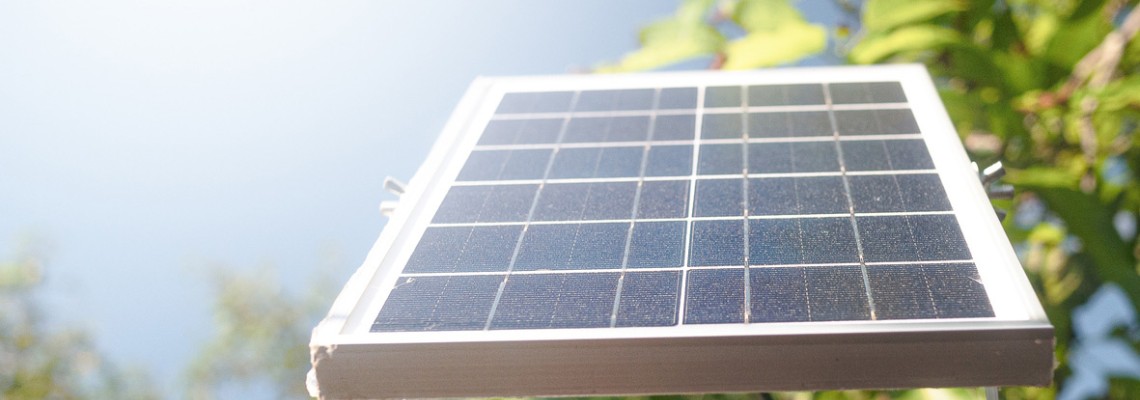
How to Choose a Solar Gate Opener: What I Look for Every Time
Hello! My name is Jay Leatherwood and for almost 30 years I have been specializing in and distributing solar and powered gate openers to the entire USA. Today lets go over some basics on SOLAR POWERED OPENERS.
Most people shopping for a solar gate opener look at just the information the manufacturers WANT YOU TO SEE. Gate weight and length. That is a trap! Then they find a product with a PRICE they like, and are convinced the specs are good enough. They are not! I’ve seen that approach fail more times than I can count — dead batteries by week three, gates that stop working after just a month or two, NO PARTS available when anything happens, solar panels that were never sized right for the load. So before we talk about specific products, let me walk you through the way I actually think about this decision.
If you get the fundamentals right, you end up with a system that runs reliably for easily 10+ years. If you skip them, you’re back on this internet trying to buy your SECOND gate opener with still no real information on where the decision went wrong to begin with. The next few paragraphs are the basics that are obvious to anyone. Swing vs slide, solar panel sizing, # of cycles per day, etc, These are basic, but to buy the REALLY GOOD opener for all those parameters, you can skip to “Climate Matters”, “Recommended Brands and Why”, and “What Engineers See and Most Don’t Understand”.
Slide vs. Swing — Why the Gate Type Comes First
Obviously an important factor in choosing a solar gate opener is whether you’re dealing with a slide gate or a swing gate. If you already have a gate installed, then it is easy to know which one you are shopping for, but if you have not installed a gate yet and are trying to decide which type is best, then this information is for you!
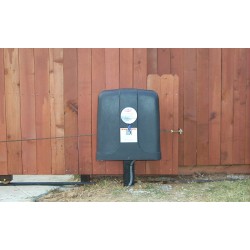
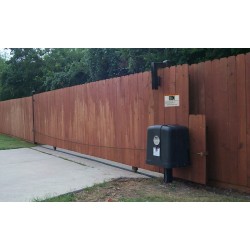
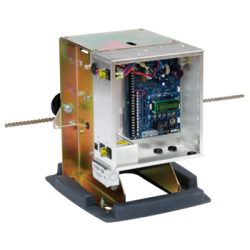
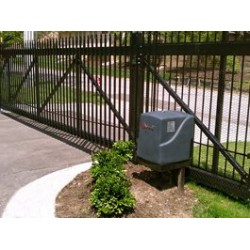
Slide gates are typically heavier because the gate will be required to support itself, where a swing gate depends on a hing post to carry it’s weight. A typical residential slide gate might weigh 300 to 800 pounds, and the opener has to move that entire load along a track every time someone enters or exits. That takes sustained power. Solar slide gate openers are engineered with larger motors, higher-capacity battery systems, and panels sized to recover that energy between cycles. A slide gate can also be used for PRIVACY because heavy winds don’t affect the “load” the gate is fighting against like swing gates do. This is often overlooked! As a result, swing gate actuators are folded in half and destroyed in a heavy gust.
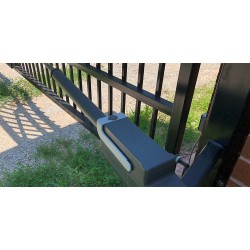
Swing gates are different. They pivot open and closed from a hinge point, and the opener only has to overcome the initial resistance and then guide the gate through its arc. The motor load is lower, the cycle time is shorter, and the overall energy demand is more forgiving (as long as you DO NOT COVER THE GATE and turn it into a sail! That’s one reason solar swing gate openers tend to be more accessible — there’s more margin for error on the spec side. We will discuss what differentiates “Professional grade openers from the “Disposable garbage” (and there is a LOT of that on the internet now) later in the article.
Start with gate type, then lets move to everything else.
Solar Panel Wattage — How Much Is Enough?
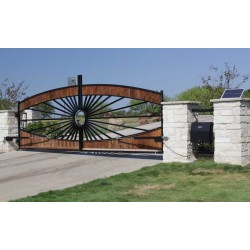
This is where I see the most confusion, and some very misleading marketing. A 10-watt panel sounds like it should be plenty. The math seems to work if you look at daily watt-hour consumption in a vacuum. But that math doesn’t account for winter sun angles, cloudy weather, shading from trees or fences, or the reality that most batteries don’t operate at 100% efficiency. Solar panels are now so inexpensive online you can purchase one that is two or three times more than you need - AS LONG AS YOU INSTALL A REGULATOR with it, to prevent from overcharging your battery.
Here’s my rule of thumb: whatever the manufacturer specifies as the minimum panel size, I want to be at or above their recommended panel, not their minimum. Most quality residential solar gate openers run on panels in the 10 to 20-watt range. Commercial or heavy-duty residential applications with slide gates often need 20 to 30 watts or more. But all solar panels over 15 watts SHOULD be installed with a regulator!
A few things to keep in mind when evaluating panel specs:
Location matters. If you’re in the Pacific Northwest, Arizona, and Houston are different solar realities. A panel that charges adequately in Phoenix may leave you short in Seattle or Vermont from November through February.
Angle and shading. Panels mounted flat on a horizontal surface in northern latitudes can lose 20 to 30 percent of their potential output. If the installation location has partial tree shade, that loss compounds.
Charging reserve. You want a system that can fully recover its battery on a typical day and still have some margin. If the math only works on a perfect sunny day, it’s not going to hold up in the real world.
When in doubt, size up. The cost difference between a 10-watt and a 20-watt panel is minimal. The difference in reliability is not.
Battery Capacity — The Piece Most People Overlook
Here is my best analogy if you don’t understand the important of a battery in the solar panel system. Think of your battery like you would a swimming pool full of energy. Your solar panel is the “hose” keeping the pool topped off. The drain opens up and lets water out every time you activate your opener AND with accessories like your remote receiver, exit sensor, safety beams, keypads, etc is constantly open a little draining your “pool”. The larger the “pool/battery” the larger your “reserve” of energy is and the less likely you will run it empty with the proper panel and regulator installed! Please keep that analogy in mind when reading the details of each part below.
Panel wattage gets all the attention, but the battery is actually where most solar gate opener failures originate. The panel collects and delivers power; the battery stores it. If the battery can’t hold enough charge to get through a cloudy week, or if the battery degrades quickly because it’s being cycled too aggressively, you’ll have problems regardless of what the panel is doing.
Look for sealed lead-acid or lithium batteries in the 7 to 12 amp-hour range for residential swing applications, and 12 amp-hours or more for residential slide gates. Lithium batteries cost more upfront but tend to last longer and perform better in temperature extremes — if your gate is in a hot Texas climate or sees hard winters, that’s worth factoring in. ALSO, you need a regulator rated for the type of battery you decide on. Different types of batteries charge at different voltages! A typical lead acid battery wants a regulator to shut off around 13.5vdc but a lithium takes up to 14.5vdc to full charge.
Pay attention to the battery’s cold-weather rating. Lead-acid batteries lose a significant percentage of their capacity when temperatures drop. A battery rated at 12 amp-hours at 77°F may deliver only 8 or 9 amp-hours at 32°F. If you’re in a region with cold winters and you rely on a solar-only system, that winter performance gap can mean the difference between a working gate and a dead one.
Also ask: how accessible is the battery for replacement? Most gate opener batteries are standard sizes and relatively easy to swap. But on some units — particularly budget options — the housing makes replacement inconvenient enough that people put it off until the system fails completely. Plan for replacement at the four-to-seven-year mark on lead-acid, longer on lithium.
Cycle Count — Know Your Daily Traffic Before You Buy
Every solar gate opener has a rated daily cycle count, and this spec matters more than most buyers realize. A cycle is one complete operation — one opening or one closing. If your gate opens and closes once, that’s two cycles.
Most residential solar gate openers are rated somewhere between 20 and 50 cycles per day. For a private driveway at a vacation cabin or a rural property with light traffic, the lower end of that range is usually fine. For a main entrance at a commercial property, a busy ranch, or a multi-tenant residential gate, you need to think carefully.
Here’s where buyers trip up: they look at average traffic and forget about peak traffic. If you have a gate that sees 10 cycles on most days but 40 cycles on a day when contractors are coming and going, and then the sun doesn’t cooperate for two days afterward, you’re going to drain the battery below the recovery point.
The safest approach is to estimate your peak daily cycles, not your average, and choose a system rated comfortably above that number. For anything above 30 to 40 cycles per day, I’d be looking seriously at either a higher-capacity solar kit or a system with a battery backup that can be supplemented by grid power when needed.
Climate Matters More Than the Spec Sheet
I mentioned solar irradiance above, but I want to come back to climate because it affects more than just panel output. Your full operating environment — heat, cold, humidity, dust, rain — determines how every component will “age” or “degrade” over time.
Heat degrades batteries. Sealed lead-acid batteries lose capacity faster when they operate at consistently elevated temperatures. If your gate opener enclosure sits in direct sun in a hot climate without ventilation, you’re shortening battery life. Quality manufacturers account for this with ventilated enclosures and component ratings for high-temperature operation, but budget units often cut corners here.
Cold, as I mentioned, reduces battery output. It can also affect the gate opener’s electronics and motor lubrication. If you’re in a northern climate, make sure you’re buying a unit rated for your actual low temperatures, not just average conditions.
Rain and humidity affect electronics and motor components over time. Look for enclosures with proper IP ratings for weather resistance. In high-humidity or coastal environments, stainless steel hardware and properly sealed enclosures make a meaningful difference in long-term durability.
Dust and debris affect slide gate tracks and the opener’s drive mechanism. If your property is dusty or the gate sees heavy debris accumulation, you’ll need to factor in more frequent maintenance regardless of what the opener’s specs say. None of this is reason to avoid solar. It’s reason to buy a quality product that was designed to handle real conditions — not just to pass a spec sheet check.
Brand Matters — What I Recommend
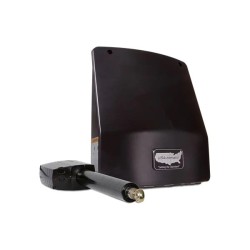
After years of selling and installing gate openers, I’ve formed clear opinions about which manufacturers build products that hold up and which ones cut corners. For solar applications, I consistently come back to a short list. Why? Short answer and probably THE MOST IMPORTANT FACTOR IN THE LIFESPAN OF AN OPENER. THE MATERIALS THEY ARE MADE FROM!! Plastic is NOT a sufficient material to last 10+ years outdoors. Steel, stainless, metal gears, casings and control boxes made from plastic simply do not last and are easy to identify. How can the average person instantly discern between quality and junk? Hint: It is NOT the price! It is the WEIGHT. Shipping weights are the dead giveaway! Quality actuator arms START in the 25+ lb weight range. The ones that weight 15 or less? PLASTIC and many times you cannot even buy replacement parts for these! They are designed to be disposable so you throw good money after bad feeding he huge manufacturers who are the “masters of planned obsolescence”!
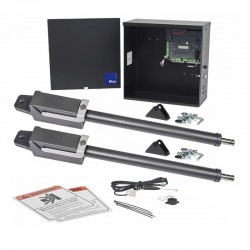
USAutomatic is my most consistent recommendation for residential solar applications, both slide and swing. For over 40 years, they have been a Texas-based, family-owned, private company that has consistently upgraded, outperformed expectations and not sold out to the huge international conglomerates. Their “Patriot” series is purpose-built for solar, with a solid battery management system and “user-friendly” installation documentation. While the Patriot is their top-of-the-line solar swing opener with a 5-year warranty on electronics, a 29lb actuator, and a full-size, black powder-coated steel, locking control box, they also offer more economical versions in SWING AND SLIDE OPENERS! They support their products with readily available parts and responsive technical support, and fast shipping if we ever need a replacement part for warranty or even just an accidentally damaged opener (oopsy’s do happen occasionally).
Nice Apollo makes well-engineered swing gate openers that work reliably in solar configurations. Their Titan 12L is a good residential option, and the broader Apollo line has earned a reputation for durability and thoughtful design.
Viking is another brand I trust, particularly for installations where longevity and build quality are the priority. While solar is not their main “wheelhouse” in their equipment line, they do build a very high-quality model VIKING R6NX SOLAR, a G5NX Solar and a Slide Viking K2SPS Solar in very high quality solar versions. Their components tend to be over-engineered in a good way — heavier than you might expect, which translates to less wear over time.
What I avoid: no-name brands sourced through generic marketplaces, kits that bundle a 5-watt panel with a 7 amp-hour battery and claim they’ll handle 30 cycles per day, and any product that doesn’t have readily available replacement parts in the US. The “Jungle” website is full of these as well as the local hardware and farm supply stores. A gate opener is a long-term investment. The savings on a cheap unit disappear fast when you’re replacing it in two years or can’t find parts.
What to Avoid
Let me be direct about what I tell customers who come to me after a bad experience.
Undersized solar panels. If the panel size is below 10 watts on any residential application, be skeptical. If the manufacturer is vague about panel wattage or buries it in fine print, that’s a red flag.
Cheap no-name solar kits. The market is full of rebranded Chinese components assembled into a kit, slapped with a US-sounding brand name, and sold primarily on price. Some of them work fine in perfect conditions. Very few of them hold up over two or three years of real-world use, in real weather, at the cycle counts people actually need. The failure rate is high enough that I can’t in good conscience recommend them.
Kits without replacement parts availability. Ask before you buy: if the battery dies in three years, can I get a replacement? If the control board fails, is there a service path? If the answer is unclear or involves a multi-week wait for international shipping, look elsewhere.
Mismatched systems. A solar kit designed for a swing gate will not work reliably on a slide gate. Some buyers try to make this work by adding a larger battery or a supplemental panel. It doesn’t solve the underlying problem — the motor and control board weren’t designed for the load.
FAQ
Q: Can a solar gate opener work in cloudy climates?
A: Yes, but you need to spec the system for your actual solar environment, not ideal conditions. In consistently cloudy climates, I recommend oversizing the panel — go to the next panel size above the manufacturer’s recommendation — and choosing a battery with at least 12 amp-hours of capacity so you have enough reserve to get through multiple overcast days without depleting below the recovery threshold. The key is buying a system with enough storage to bridge the gaps.Q: Do solar gate openers work at night?
A: Absolutely. The solar panel charges the battery during daylight hours, and the battery powers the opener at night and on cloudy days. As long as the system is properly sized and the battery is in good condition, you shouldn’t notice any difference in performance at night versus during the day.Q: How long do solar gate opener batteries last?
A: Sealed lead-acid batteries typically last four to seven years depending on climate, cycle frequency, and how well the charge management system protects them from deep discharge. Lithium batteries generally last longer — often eight to twelve years — and handle temperature extremes better, but cost more upfront. Either way, plan for battery replacement as a maintenance item and factor it into your total cost of ownership.Q: What size solar panel do I need for a slide gate opener?
A: For most residential slide gate openers, I recommend a minimum of 20 watts, and 30 watts if you’re in a northern climate with significant winter shade or cloud cover, or if you’re running higher daily cycle counts. Slide gates draw more power per cycle than swing gates due to the gate weight and continuous motor load. When in doubt, size up — the cost difference is small compared to the reliability gain.Q: Can I add solar to an existing gate opener that runs on AC power?
A: It depends on the opener. Some gate openers are designed to run on either AC or DC power and can be converted to solar with the right battery and panel setup. Others are AC-only and the control board isn’t designed to operate on DC power from a battery. Check with the manufacturer before attempting a solar conversion on an existing AC unit. In most cases, if solar is a priority, you’re better off with a purpose-built solar gate opener from the start.Call Gate Openers Direct
The right solar gate opener is the one that’s sized correctly for your gate type, your daily traffic, and your local climate — and built by a manufacturer who stands behind their product. Take the time to get those fundamentals right, and you’ll have a system that runs reliably with minimal maintenance for years.
Ready to start shopping? Browse our solar slide gate openers for slide gate applications, or our solar swing gate openers for single and dual-arm swing gate setups. If you have questions about which system is right for your property, reach out — I’m happy to walk through it with you. That is my job! We offer personal assistance with quality recommendations, fast service and LIFE TIME TECH SUPPORT on everything we sell!